I first met James Munro Leaf during my time at Harvard University in 2007. James, may he forever rest in peace and power, was a phenomenal poet, playwright, educator, visionary thinker, and connector of peoples across this planet through his art and open and genial personality. A man who carried a fire within and surging drive to transform the United States and the world for the better through his passionate expression in the arts, James was also intimately aware of the burden that artistic gift sometimes itself carries. He wrestled with the vicissitudes of this life and vicissitudes in his spirit and mind, and when we connected in Currier House as fellow dorm residents, we quickly began to exchange on all manner of subjects from poetry, to shared struggles in the scholastic environment, to political critique and reflections on the energy needed for transformative global change. James’ knowledge was supremely expansive, and he could relate to all aspects of my vision, bringing references from esoteric and lesser known European revolutions and thinkers in alignment with my African, black American, and hip hop/Diasporic poetic foundations. His literary well ran very deep, and I enjoyed sharing with him on all manner of writers, especially at that time Paolo Coehlo, whose Warrior of the Light Manual had inspired me. Thinking of James, I think of Ginsberg’s Howl alongside Frostian, Shakespearean, and Classical Greek and Roman poetics simultaneously wrapped into piercing insights on our post modernity forever connected to the movements of the past. Though I would not get to see him after our time together in university, I learned that he brought his great presence of creativity and knowledge across the world with the same intensity and truth telling love that he inspired me with in the university. To his beautiful surviving family and all his great friends, particularly Jugoslav Kapetanovic, thank you for helping me to see more of the deeper picture of his beautiful soul. To Dr. Liz Goodenough, James’ mom, and the whole family, thank you for the gift of your son and for the encouragement to share this work he gave me in university after one night I stayed up late rapping in the cold Cambridge winter. Just a small opening into James’ multidimensional pen, I hope in sharing this work one can see James’ fierce kindness to me and to the world. There are many many more of his works which I hope to see someday in full publication that would give deep insight into a man supremely sensitive to the world, the lives of others, and the battles for mental, physical, and spiritual well being as he charted a path for a transformed world of sincere empathy.
From Robert Ellsberg
On Dec 21, 2017, at 3:19 PM, Ellsberg, Robert wrote:
Dearest Liz and Gil,
Forgive me for intruding in this unbearably sad moment. I just heard the news from Peggy, and of course I had to reach out to you with love, despite the fact that we have been out of touch, and words are so inadequate.
There is no consolation I can offer, but please let me express these words that come from my heart (and forgive me for any presumption):
There is no measuring the suffering that Jamie experienced. Whatever calculation went into his last act, I’m sure it was never intended to hurt or punish you, or to lay any burden of guilt or recrimination on you. Of course, that does not spare your feelings, but I am sure that whatever went on his mind—whether impulse or conscious plan—it was intended only to ease his own pain and not with a thought to the pain it would cause you. Try to forgive him.
Ultimately you were powerless to rescue him—though you both did everything that was in your power to help, and spared no effort or expense on his behalf. He could not have had more loving and dedicated parents. Try to forgive yourselves.
Though he experienced suffering beyond what I can imagine, his life was about more than suffering. He was a hugely gifted and brilliant person. He was loved by many people and he experienced love. Apart from the pain, he had many experiences of happiness, and he also brought happiness into the world. I was fortunate to be present for many of those happy occasions. I remember in particular how much fun we all had working on jigsaw puzzles at the lake, with all the boys shouting out “Brilliant!” whenever anyone found the missing piece. I remember his kindness to my girls, the great impression he made on Peggy’s classes with his brilliant literary gifts. I remember so many times that he and Nicholas spent together.
The last time I saw him he was with a girl at the Tribeca film festival where Nicholas was showing a film. He was cheerful. He greeted me warmly, and it made me happy to know that he and Nick had maintained a connection that was forged when they were infants.
Of course I knew Jamie from the moment he was born. I remember how you both glowed with happiness. He came into a world that received him with love. But he carried a weight that he ultimately couldn’t bear . . . and who can blame him, or know that we would not have done the same.
Dorothy Day was very troubled by the suicide of a friend’s son. She asked a priest how to pray for this youth. He told her something that she never forgot—it must count as one of the most important spiritual insights that anyone ever shared with her. He said, “There is no time with God. All the prayers you would have offered for this boy while he lived are still valid and effective.” This brought her much comfort over the years, as she suffered similar losses. (Dorothy herself, as a young woman, twice tried to kill herself.)
Apart from the gift of life, God has given us the great gift of freedom. Surely Jamie did not choose darkness but freedom from suffering that had become intolerable. (Again, please forgive me if I don’t know all the circumstances or make assumptions I have no right to.)
I love you both and I pray with all my strength that in the days to come you will find the support you need to get through this now dark season, and that beyond that you will be flooded with memories of the sweetness and joy that you shared with your darling son, and experience gratitude (as I do) for having shared the earth with him for this all-too-brief time.
May you find peace, may you find healing—not today, or tomorrow, but with the inexorable passing of time; may you be wrapped in God’s loving embrace; may you finally come to know that wisdom—which no one desires and no one seeks—that only comes by way of fire. And afterwards, the still small voice.
With love and sorrow,
Robert
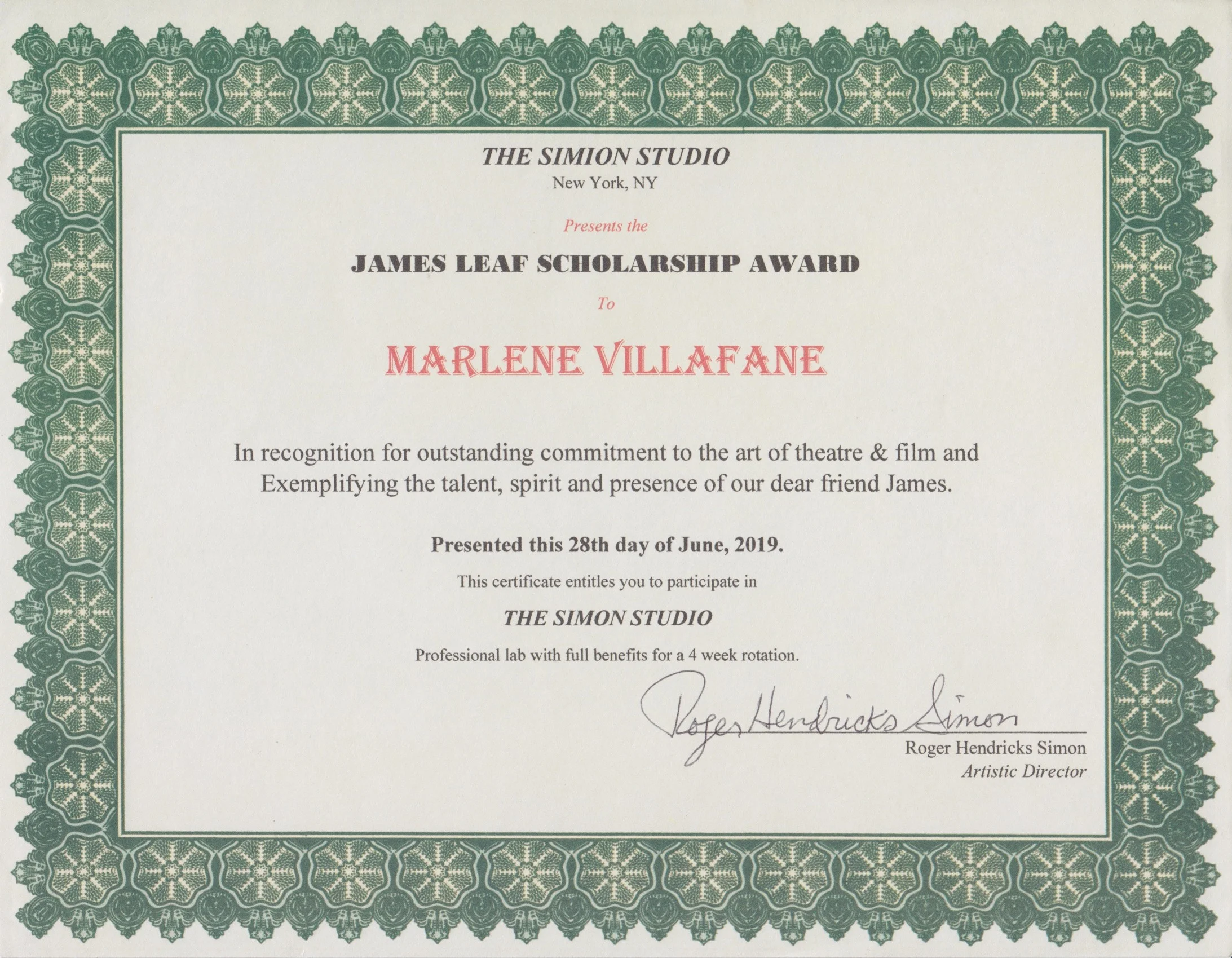
Marlene Villafane - 2019 James Leaf Scholarship Award Recipient
From: Marlene Villafane
Date: Sun, Jun 30, 2019 at 12:51 PM
Subject: Heartfelt Thank you! A must say.
I had to say beforehand asap and before July 4th hits, to you Roger and all of you how grateful i am to have received the James Leaf Scholarship. Of course without all of you this could not never have been possible. We heard numerous times and rightly so about James Leaf. I heard one on one from others who knew or remember him personally how outstanding an actor he was with a magnificent fire and power when performing Shakespeare as well. I wish I l had known him before. I believe we were also told what a kind human being he was. Any way, I was deeply taken by how he left this earth and although hes been gone for quite a bit may he spirit fully rest in peace. In knowing all of this, thank you James Leaf for apparently the beautiful impact you've made on the people who knew you. I am indeed grateful as i am anyway and thank you again Roger and all of you. I love you all so very much!!! Being able to come to class as much as i could and work with all of you has been one of the hugest highlights in my life! Something to always look forward to going to that gives me joy! Be safe. God bless you. Hope you're weekend is going splendidly and have a great 4th of July! - Marlene GRACIAS!

Michael Gould-Wartofsky
From Bharti Jogia-Sattar
12.20.2018
My Dearest Jamie:
Last night, just like many other nights this year, I keep rewinding the clock to when you were 6/7/8 years old.
In my heart, whenever I think of you, you will forever be “my Jamie”; my Jamie who inspired me to tell Ramu stories, give piggy-back rides and one who loved this stranger, unconditionally.
You had your unique style with the oversized T-shirts and no shoes, the small leather pouch with beads tied around your waist, your hair-always a little long, your beautiful eyes-always full of confidence. I will always admire that confidence and your charm.
I miss you, my dear Jamie. Wishing that if only I had stayed in touch more and been there for you more, perhaps, I would have tried to protect you from the Dementors (Harry Potter reference that we shared).
Hope that you are able to enjoy sticky rice with mango and touch souls of all who have the good fortune to be around you.
Love you forever.
-Bharti
A Note From Julia Renaud

Brigit Young Letter
March 24th, 2018
"Dear Simone,
How could I ever describe my friend, my family, James Munro Leaf, to you?
One of the only times you met him, you were quiet, and slept on his chest, and didn't cry, and I said "She likes you." And he said, "Oh, that’s good. That must mean I'm a good person. Babies and dogs. They know good people." When you fell asleep, we went on my balcony and looked at the city below us.
I'll remember him like that. Knowing you, watching the world, floating above its struggles.
And he was a good person.
One day, when you're older, but not too much older than now, you will meet a friend who sees you. Who is drawn to your quirks and idiosyncrasies and more obvious flaws. And you'll be drawn to him, too. To his ability to question authority until authority buckles under the weight of his genius, to his infectious and uninhibited laughter, to his poetry, both the written kind and the kind that lives right under his skin, giving him a poet’s glow. And together, you'll run lines for plays and make inside jokes so glorious and so private that anyone who hears you laughing feels the sting of not having that special spark the two of you have, and together, you'll dance in the rain, and he'll encourage it, remember it forever, years later asking you at least once a year, "Remember that time we danced in the rain?", and you'll get older. And you'll become teenagers and fall in love with other kids and he’ll tell you about the stars he and his love looked at together under in the Arb and how, at that moment, everything was perfect. And you'll ask him if staying up all night makes your breath smell bad and makes kissing gross and he'll say, "That's the best kind of kissing! Because it's real!" He’ll teach you it’s important to be real. And you'll grow older, and you'll move away. And you'll find each other a bit later, as kind of-grownups, who get depressed, who get sick, and for brief, beautiful moments you'll laugh your way out of it together. And you'll love each other the way you love family you choose.
And one day one of you will not grow any older. And when that happens, hold his memory close to you. Think of him every day. Call him to you - what he would say, what he would laugh at, how he would rage at the inequities surrounding you, how he'd smile lovingly at your tears over him. How he'd tell you not to worry. Hear his voice. Always listen to his voice. And pass on that voice, speak it for him.
I will pass on Jamie when I encourage you to dance in the rain. When I recall memories of it with a gleam in my eye. I will pass on Jamie when I sing you old Scottish and Irish folk songs as you fall to sleep. I will pass on Jamie when I tell you the stories of Shakespeare with a passion that comes from the gut, from the loins. I will pass on Jamie to you when I call someone in a position of authority a fascist or tell you that to protest you need to revolt. I will hear his voice, and though it may be altered slightly, like a game of telephone, I'll tell you what he says.
It won’t be enough, but it will be something.
Love,
Mommy"
(Brigit Young)
Sean Fredricks Email
March 5, 2018
Dear Liz,
I got your email from my friend Jugo Kapetanovic. I am very sorry I am just reaching out now. I wanted to write to you to express my condolences (and those of my fellow Harvard classmates, Simon Nicholas and Rowan Dorin). We were extremely distraught when we heard of James’s passing. We directed James in Ben Jonson’s The Alchemist at Harvard when he was a freshman and found him to be a young man of exceptional talent and work ethic. I’d love to relay how important James was to our show and how fondly we remember his contribution.
From the beginning, we had a difficult time casting the play. It was relatively unknown to modern audiences yet required great facility with Elizabethan language, more than even Shakespeare. We auditioned hundreds of actors, and in the end our leads chose to do other plays. As a result, we were forced to take a risk on newcomers to the Harvard theater scene (and ones who could read speak Elizabethan verse convincingly).
James was one of those new actors who quite literally saved our show. He was absolutely hilarious, with his gravelly voice and his easy access to an absurdly comical anger—both of which were qualities that fit perfectly with his character of Kastril. Due in large part to James’s talent and commitment, our show was an enormous success. We had to turn audience members away since we were already far above capacity and crammed more people into the Loeb Experimental theater than ever before, at least in our time at Harvard. Professor John Parker loved the show and—thanks to James and the rest of the team—told us that we had brought Jonson’s play back to life.
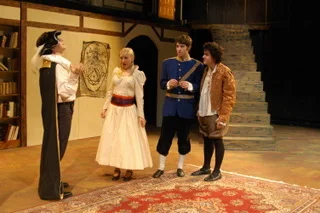
One thing we discuss often is a moment in rehearsal when we were blocking a very large scene, and James came up with the most amazing characterization. To describe it in words is near-impossible, but it was a kind of loping, hunched, almost drunken-boxing-like stance, with a hilarious hand gesture that his character used to “quarrel.” It was one of the funniest things we’ve ever seen. I’m very thankful we actually captured this moment in a photo (attached). As I think you can see from a few of the photos, James’s energy, commitment, and humor were infectious.
We will never be able to read or think of The Alchemist without thinking of his James’s line readings. We recently re-read some of his scenes together and laughed out loud when we remembered how James read them, especially words like “suster” and “I’ll maul you.” Every time he appeared on stage, he made us laugh uncontrollably.
Often the rehearsals were taxing, especially with such a technically-challenging play and with so many inexperienced freshmen)—but we cannot remember one time James complained or added to any dynamic that was unhelpful. He was always collaborative, professional, and enthusiastic, no matter how he may have been feeling.
We all wish that we had gotten to know James even better, but we can say without a doubt that he truly, truly loved the theater. We feel blessed that we knew him and were lucky enough to work with him. We’ll never forget him and how he contributed to a wonderful and successful time in our lives.
Attached are some publicity photos we took during The Alchemist. I’ve tried to dig deeply and see if there were any recordings of the show, but unfortunately I haven’t been successful as of yet. I will of course forward anything I find in the future.
Sincerely,
Sean Fredricks
Simon Nicholas
Rowan Dorin




Cheryl Grace Letter
December 31, 2017
Southampton, Ontario
Canada
Dear Gil, Liz and Will:
Jamie has been in my thoughts since I learned of his death late last week, but I’ve also thought of him often and fondly in the years since he graduated. My heart aches for you.
I’m sorry I wasn’t able to attend Jamie’s memorial service yesterday. I live in Ontario, Canada now, right on Lake Huron. Jamie told me your family owned a place in Grand Bend, so I’m sure you’re familiar with the snow squalls and difficult driving we’ve been experiencing recently.
I wanted to let you know how much Jamie means to me. He was one of the most gifted and memorable Mock Trial students I ever had who could run circles around the opposition, as a lawyer and a witness. Jamie was part of that extraordinary cohort of students who joined the team in the fall of 2000: Maggie, Helen, Zahreen and Alice, who started as ninth graders and stayed faithfully with Mock Trial for four solid years. Jamie made us laugh, shake our heads in wonder at his brilliance in trial and rehearsal, and sometimes make the coaches want to tear our hair out when, in his passion, he forgot about the timer in trial. I still remember a judge in a state championship final round during his junior year calling Jamie the best Mock Trial witness she’d ever seen. In his senior year, Jamie made the defense closing argument in the championship round; it was so strong and effective that I used the video as a teaching example for future teams.
As you know, Mock Trial is much more than the competition. We spent so much time together in rehearsal, and I know the kids spent even more time together themselves. I never saw Jamie be mean or ungenerous towards his peers or his elders. I remember a couple of days before the state finals one year, I had been reminding students to get their trial clothes ready, haircuts, etc. It was Thursday night rehearsal, and Jamie still hadn’t gotten a haircut, despite my and a couple of the girls’ nagging. I asked him if I could give him a ride to the barber the next day sometime before we left for the tournament. He looked at me with the sweetest smile, and said, “Cheryl, you don’t need to do that”. Sure enough, when we assembled at 3 PM the next day to head to Lansing, he showed up with his hair trimmed, part of the team.
Jamie was gifted, but was never arrogant about his gift, enriching all of us through his wit, kindness and friendship.
With my deepest condolences,
Cheryl Grace
From Cricket Gordon
I’ve known James for years. His first two decades, he was called Jamie, and it’s taken me forever to think of that once adorable toddler as James. I remember as a young child, Jamie had the biggest, deepest brown eyes that peered out from dark lashes and shaggy bangs. When we talked during walks in the woods or while sitting in the backseat of the car,
he would turn up his face and look into my eyes. He asked me so many questions. I was always struck by the breadth of things he “wondered" about.
James never lost his curiosity, his ability to ask questions, or his expectation to learn from his friends' and colleagues’ responses.
Two summers ago, James and his dear friend, Luisa, lived in my house while directing a play in Buffalo. It was a complicated play set in some of the original ruins of the Erie Canal. The weather was tricky, and there were a few unreliable deadbeats in the cast. James, Luisa and I spent many hot summer rehearsal nights on my front porch eating "take out " while discussing the most recent “ challenges” of the day. James would look me in the eye and ask what I thought about a certain scene or song or dance. He was interested in my opinions and believed I had something of import to add to the discussion. I witnessed him demonstrate this questioning, inclusive quality with his actors, as well. He was a strong, passionate director who harbored no fear of sharing the growth and shape of the production. During rehearsals, he would squat down on his haunches surrounded by the cast and pose probing questions, aways expecting and listening to their input. There was a fierceness about his work. He was demanding, while at the same time able to respectfully include everyone in the process of bringing the production to life.
I learned a lot from James that summer. Never have I witnessed such passion and tenacity. He was determined to make that play with it’s crazy cast a success. And, of course, using his marvelous ability to tease ideas out of his team and incorporate them into the plan, he did it.
I love James, and still covet the Tree of Life earrings he and Luisa gave me at the end of the summer. Although James is no longer on Earth, he will always be part of the Tree of Life which is with us forever.
Cricket Gordon
From Gil Leaf
"He persevered and remounted his horse 11 times after manic episodes, but with so many physical problems related to his medicines' side effects, he could not see a dignified or purposeful way forward. The repeated trauma of incarceration and restraints was too much to stand for the wild bird inside him and had much to do with the poisonous alcohol he took for the pain. I was with him for a full year in his suffering and could not but marvel at his courage and his continued consideration for others. While he was sloppy about lots of life’s requirements for discipline, he lived in an artistic and creative universe that was kind of oblivious to these norms. He wanted, if able to carry on, to use his art to help others in pain with mental disease and its consequences. He went to the Falls both as a portal to another place without the pain and as a purifying and dramatic exit that would leave his parents and friends without a mess and uncertainty about his ownership of a carefully planned decision. Niagara was his barricade or the breach he stormed."
- Gil Leaf
From Tom Dingman
Dear Liz and Gil: My heart absolutely breaks for you. I can't imagine what you are going through. Jamie was brilliant. I think immediately of the difficult theater projects he took on, his excelling in chess and debate, and his instinct to create an even playing field for all. At a time in his life when he could have been focused narrowly on his own development, he actively worked to better the wages of Harvard's least well paid employees and he befriended folks who were struggling to fit in. I always admired his restless spirit and his courage to do things differently, like create his own concentration. He was a loyal friend (man, he had some beautiful girlfriends) and for all his health battles did not lose his playful spirit.
I remember you writing when Jamie was on leave during what would have been his sophomore year and sharing news of both your mother and Jamie, saying that your mother's mantra for all tough things she was encountering was "It's for Jamie". What a nice sentiment. I am going to carry that myself and stretch as Jamie did to think less like a bureaucrat and more like a poet, and to consider more often the circumstances of those without privilege and do what I can to treat all with kindness and respect.
I hope we can talk. Afraid to interfere but I'm here and thinking of little else. Hugs, hugs, and more hugs, Tom
But she has lived and still gives life...
Jamie's poem about Paris ends with an image of a little girl holding high a piece of bread "where fluttering sparrows alight to nibble from her hands". Like to think that Jamie is free as the sparrows, not burdened by illness, and connected to those still wandering in the garden, grateful for his life but feeling diminished by his loss.
From Brigit Young
Dear Liz,
Words could never do justice to my sorrow at your loss. I think of Jamie and what he would say, and I think he would like the Sappho quote, "What cannot be said will be wept."
I do not wish to bother you during this time, but merely to offer, one day in the future, to collect Jamie's poetry and writing from various friends and send them to you. Additionally, I have a few photos of Jamie that I would love to share if you want them at any time.
He was a true original, full of love and magic, and I adored him from the age of 12 onwards. I am thinking of you and your family every day. If there is a service, I will see you there. If not, I will continue to send my wishes for love and peace to you.
Love, Brigit
From Georgia Shreve
Stacey let me know last night.
Depression has been a battle fought (or left unfought) in my family forever.
I have fought deep depression all my life.
I know its agony to some degree.
But I hate to think of how much he suffered and for so long.
He was truly one of the most extraordinary people I have ever known in my life—and I deeply wish I had known him better.
His command of the language, literature, theater, the full human scope, was awe-inspiring. He was truly a genius by any measure.
He was a brilliant actor, playwright, and director who would have been inspiring thousands if it were not for theater selling out to Disney.
But genius is often accompanied by painful struggles. Why so many richly, deeply, brilliant creative people are stricken with
such agony has yet to be resolved. Of course part of it is chemical and biological, but I think much of it is the acute sensitivity of every sense and mental process to the intricacies of the world and to each individual person with all their flaws, defects, and miseries.
I feel so honored and touched to have known him. And so miserable that I did not have the privilege of knowing him better.
The agony you must be going through is most likely the most acute there is.
James sent me a poem once that inspired awe.
Enormous talent is sometimes burdened with enormous pain, one of the tragic ironies of life.
I am and always will be here for you if I can in any way mitigate your grief.
If you feel up to it, send me the poem from his computer.
I have suffered enormously with my son Gregory who has been in and out of psychiatric institutions for 20 years.
So I can understand on some minor level some of your suffering. But geniuses with their rarity and preciousness are like
orchids that weather the world with difficulty.
Above all never forget that you were as loving and caring and attentive to your son's needs as it is possible on this earth to be.
And that with your love and care and wisdom you raised a rare genius.
I wish, as many must wish, that I had shown James more visibly my love and admiration of everything he was. New York is a cruel world and helps crush many spirits.
But his spirit weathered so much of it.
With all my immense love and sympathy and care to you and Gil.
No one should have to undergo such pain as James did and which you have for so long and have to sustain now. That is all that in my helpless, meagre, humble way I know how to say.
With a world of love and respect and sympathy for all of you,
—Georgia SHREVE
From Ellen Quigley
James was magic and he was made of love. For some reason his giggle has followed me around these few days, and it is almost unbearable. If this kind of anguish is what this odyssey of a week has been for me . . . I can't imagine what it must be like for you. You did everything you possibly could have done, everything. And he suffered so unduly, so unfairly -- never was a person's suffering more undeserved. You raised a truly special human being and now he's gone and we'll all have to find a way of carrying him around with us in a way that isn't devastating. But I've carried him with me for all the 12 years I've known him and can't imagine doing otherwise.
The last time I saw James in person was a couple of years ago in New York. We wandered for hours and had the most healing conversation of my life, without question; he released me from a lot of guilt I'd felt for years, and explained a few things that had happened when he was manic such that a narrative was able to click into place for the first time. But he wouldn't accept the same reassurances and explanations from me; he couldn't accept that his illness wasn't his fault, and that the manic version of himself wasn't core to who he was somehow. That he was one of the kindest people I had ever met, of a sort that seemed instinctive somehow. He would never take the slack he so readily gave others. That night he quoted liberally from a play (can't remember which) and from a Walt Whitman poem . . . and sang an off-tune Barrett's Privateers. What a marvel he was.
Ellen Quigley
Eulogy for James Leaf by Chloe Frank
James and I met at Harvard in a poetry seminar in 2008. He had this cool maroon leather jacket and his hair was long and wild. He was scarce and audacious: he rarely showed up for class— “has anyone seen James in the last month?” the professor once asked—and when he did show up, he would regale us all with his curmudgeonly, sharp analysis of a Bishop poem or zero in on Lowell’s romantic history. He was clearly whip-smart; a magnetic, compassionate, grumbling old soul.
I adored him immediately, and took it upon myself to locate and befriend this brilliant, brooding character. It was successful: by summer we were an inseparable, unlikely pair. I was an athlete; he was a chain-smoker who lived in his head. And yet, we found rich common ground: together we discovered new poets, sang Tom Russell ballads about buffalo and Indians and death on the frontier (James was endearingly tone deaf, which never stopped him), drank whiskey at Daedalus and ate nachos wherever they were served. Whenever he dropped a cigarette butt, I would jump as high as I could into the air and stomp it out, sticking the landing like a competitive gymnast. He would buckle over with laughter, then light another.
James called me “Turbo.” I called him “Munro” (his middle name) but also “Jemz,” as if I were a middle school French teacher, or a SPAM author writing from a fake African consulate, asking for a wire transfer of 100,000 USD. (We both saw the poetry in spam emails, and would frequently forward them on to each other, with comments like “truly worth your time.”)
I worried about his health and would nag him about it. “We know I am not healthy!” he would exclaim, as if health were something fixed, like the color of your eyes. Then he would make up excuses, casting us as a foil, saying things like: “You are a loaf of whole grain bread—whereas I am more cheap mescal.”
That summer, most memorably, we walked around sweaty Cambridge listening to the same song on repeat—each of us with an earbud, attached to each other via my iPod like a wishbone. Our song was, and will always be, Mark Knopfler’s “Done With Bonaparte,” the live version with Emmy Lou Harris.
“Save my soul from evil, Lord,” rings the chorus, “And heal this soldier's heart / I'll trust in thee to keep me, Lord / I'm done with Bonaparte...”
We lived that song, casting ourselves at the front lines of the action—weary soldiers in Napoleon’s army, “torn piece by piece” by Cossacks, “a frozen starving beggar band,” stealing each other’s scraps “like rats.” He was into a girl of French origin at the time, so we imagined she was the “flower of the Aquitaine” referenced in the song—his “one true love” that awaited him back in “belle France.”
That summer, “the world was ours,” as the song goes.
***
I can’t speak fully about my friendship with James without mentioning his darker side: his relentless Shakespearean, existentialist core; the singular pain he suffered.
“This is how we live our lives isn’t it?” he wrote during another difficult winter. “Just our little scene. Oblivion on either end.”
Most often, James would use the chorus of our Bonaparte ballad as shorthand to communicate the level of his spirits.
“But am I really done with Bonaparte?” he would sometimes ask with optimism, before signing his emails with the singular “J,” mimicking Napoleon’s signature “N” signoff.
“I couldn’t be more done,” he wrote me a few years ago. “Winter has been bleak, cold and melancholic. I feel lost in a blizzard on the Niemen, devoid of much purpose.”
“I am not done with Bonaparte! I am not sick of being a man!” he once wrote me in a happy rebound, “I am still ripe for the plunder brothers! I have a few more war woops left.”
Pondering the twists and turns of civilization with a joyful hope, he wrote on another occasion: “I have been trying to discover why the wars of the early 19th century have dug their claws so deeply into our (yours and mine) collective imagination. I don't think it's just the uniforms— maybe it's that there are still great and glorious causes to believe in that are fresh.”
James always seemed torn between two poles: as seduced as he was by a dramatic “throwing in of the towel,” a dark urge that always lived deep inside him, he seemed equally animated by man’s undying potential for change, his revolutionary spirit. Years ago, he introduced me to the poem “The Quitter” by Robert Service. He adored the last line especially: “Just have one more try — it’s dead easy to die, It’s the keeping-on-living that’s hard.”
My correspondence with James—the highs and the lows—has been one of the greatest joys of my life.
***
While there was a seemingly unstoppable current of histrionic fury that ran through him, James could also be the kindest, gentlest soul. This duality was so special. To his friends especially, he was supportive and generous, an unrelenting alley—wise beyond his years, always willing to lend an ear or solid advice. James could also be deeply affectionate. He put all those he loved on a pedestal. He saw the best in you, and made sure you knew it. With James, I felt “seen.”
Our friendship in particular was characterized by a grandiose, fierce loyalty that sometimes took on a funny, nepotistic flair. Senior spring, James cast me in a minor role in Lysistrata, without an audition despite my lack of experience and visible anxiety on the stage. That play, and many others, demonstrated to me what a committed and talented dramatist he was. I’m so grateful he allowed me to be a part of it.
***
James could be deeply humorous. He knew how to suck the marrow out of life. When we got together over the years after college, we would break out in giggles like a pair of mischievous kindergarteners.
My fondest, most recent memory of being with James is from April 2016. We sat outside in West Village and ate delicious BLTs; he drank green tea and I had beer until the sun set. It was warm and windy. We laughed about how on earth he would pull off a musical he was hired to write and direct that would celebrate the history of Buffalo, specifically Buffalonians. He talked with great animation about the role of the canals in early industrial America. He was sober and strong—cheery even. He had a twinkle in his eye, and I remember noticing his pretty dark eyelashes. We discussed his show “Cockpit” and his romantic life. We spoke openly, riding high from the giddy taste of familiar friendship.
The next day, James wrote me a stunning email about Oscar Wilde and the value of friendship, expressing gratitude for ours. It is one of the most moving letters about friendship I have ever received—and I have savored it countless times since.
Looking back on it now, it reads like a goodbye. But then again, in a moment like this, so can all of it.
***
So James, you’ve carried out your final act. You’ve thrown in the towel.
You’re finally, finally done with Bonaparte.
Here is what I would say to you: I am not done—at least not yet. I’ll think of you whenever anyone flicks a cigarette to the pavement; when the spring sun sets a Sherbet orange over the Hudson; when I hear the melody of the frontier, of adventure, of revolution; the song of fierce resignation or quieter defeat. But most of all, I will think of you—sweet Jemz, raging Munro— when I hear the song of enduring friendship. I’m still out here, “keeping up the good fight” as you would often say—both earbuds in, missing you.
***
Almost a decade ago, in poetry seminar, James and I discovered the poem, “As I Step Over A Puddle At The End Of Winter, I Think Of An Ancient Chinese Governor” by James Wright. Today, in closing, I want to share it with you in his honor:
And how can I, born in evil days
And fresh from failure, ask a kindness of Fate?
-- Written A.D. 819
Po Chu-i, balding old politician,
What's the use?
I think of you,
Uneasily entering the gorges of the Yang-Tze,
When you were being towed up the rapids
Toward some political job or other
In the city of Chungshou.
You made it, I guess,
By dark.
But it is 1960, it is almost spring again,
And the tall rocks of Minneapolis
Build me my own black twilight
Of bamboo ropes and waters.
Where is Yuan Chen, the friend you loved?
Where is the sea, that once solved the whole loneliness
Of the Midwest? Where is Minneapolis? I can see nothing
But the great terrible oak tree darkening with winter.
Did you find the city of isolated men beyond mountains?
Or have you been holding the end of a frayed rope
For a thousand years?
From Jeremy Funke
Well, hell.
I first met James when he was the youngest member of a cast, playing the oldest character, in a production of Richard 2 I happened to be dramaturg on. Even then his intelligence and talent shone, but I had no idea what was to follow.
Cut to a few years later, and he called out of the blue, saying he was thinking of moving to New Haven. We quickly passed friendship, and became collaborators and counselors to one another. We shared stages in Urinetown and Sister Mary, supported each other at Elm and Putney; he directed me in Catastrophe and The Big Knife; when we tired of marathoning BSG, we turned our pens to the page and churned out draft after draft of scene after scene.
We’d go toe to toe on Hamlet, and more often than not, break even.
We’d chain smoke in my kitchen or at Christy’s, where I’d request a tune from Allen <https://www.facebook.com/allen.gogarty?fref=mentions>, and you’d sing along to another. And another. And another. You invented the St. Samuel Beckett (a shot of Bushmills dropped into a pint of Magners).
I’d struggle and you’d offer advice. You’d struggle and I did what little I could. You came to Taunton for the holidays and dazzled my family with your wit, charm, and prodigious mind.
You made the time (on basically no notice) to raise a glass to me on my 35th birthday, and many others before.
You tried to convince me Midsummer was a good play, and you came closer than anyone else.
You despised social media, as it turns out rightfully, some might say presciently, so. So you’d hate this post, and the others I’ve seen lamenting your passage from this world into the next. But this is how we’re dealing with this now.
From Anusha Deshpande
December 22, 2017
Dear James,
It’s been a bit more than a week since we lost you, but perhaps we’d been losing you for a while. The deep irony is if I were writing this for anyone else, it would’ve been you I emailed for advice on how to sound not cliché. Because I can’t do that, I’ll need to do something I’ll have to get used to – going off of what you taught me and using that knowledge to take wobbly steps forward.
When I called our mutual friend from college to break the news that you’d died, he sighed. “Fuuuuuck,” he said, drawing out the “u” out for several beats. It was an exclamation of resignation. Resignation that we hadn’t been able to save you, that we’d all failed.
The last time I saw you was in Union Square, playing chess with the semi-homeless Khmer Rouge survivor you called your best friend. I don’t know a single other person who could truly see others without all the classifications that society imposed. I recently read about two theories of human existence – the artichoke theory and the onion theory. The former held that man (or woman, #ThisIsWhatAFeministLooksLike), like artichokes, had a central heart that could be viewed if you peeled back all social distinction while the latter held that humans, like onions, had no central essence and if you stripped away all the layers, there was nothing left. I think you were in the artichoke camp. Not only did you see people’s central heart, but you also never judged them on anything in the outer layers.
It goes without saying that I miss you, but I’ll say it anyway. I miss your laugh – truly the best laugh of anyone I know. You laughed with your whole body, like your delight with a joke was so huge that it bubbled out of every toe, every finger, every curly hair on your head. I miss the way you spontaneously burst into Scottish songs when we walked from Columbia to Battery Park. I miss coming home to you smoking on our balcony, as though our apartment was a 1920s Parisian café that I’d stumbled into in the midst of Boerum Hill.
I miss your emails, when you wrote that Samantha’s cat Boris was your “resident lethal Russian highwayman in the body of an imaginative, aggressive, and devastatingly beautiful cat” and when you chastised the cast of Cloud 9 for missing rehearsal – “Beginning next week, Anusha and I have no good moral or contractual reason to feel constrained scheduling rehearsals when we see fit. Besides, you are all actors. This is the most noble form of human art you can aspire to. Rehearsal is a blessing, not a burden. THIS IS FUN, DAMMIT.” I replay your portrayal of Walter Burns in The Front Page over and over again to remember your comedic genius. The Crimson review – which didn’t do you justice - wrote of your performance:
“From his abrasive language to his overconfident swagger, Leaf creates the image of greedy, devious businessman. ‘Expose ‘em, we’ll crucify them!’ he says. ‘This ain’t a newspaper story – it’s a career! They’re gonna name streets after you!’ Leaf persuades Halprin with an overpowering tone and a gravelly laugh.”
Even the way you died had your eccentricity, your dramatic flair. I imagined you carefully choosing the spot, vetoing all NYC-area bridges as being too cliché. I’m sure there’s an Irish poem about Niagara Falls that drew you there that we’ll eventually find.
James, I failed you in so many ways, and I’m so sorry. I should have said more, reached out more, spent more time with you. I missed your play, Cockpit. I couldn’t find you a new roommate. I missed your 31st birthday party. I wish we’d been able to debate together or finish the parody of Eat Pray Love we always meant to write together (which we renamed, respectably, Gorge, Fart, Snorkel). Somehow, I convinced myself that you hadn’t grown up, and the gap between us had widened, perhaps irreversibly. It took your death for me to realize that you were much wiser and grown up than me. I’d spent my twenties painstakingly adding accolades to my resume and Instagram feed, spending more time crafting those artichoke layers, instead of removing my barriers and allowing myself to truly feel. You felt more in your 32 years than most people would in a lifetime, knowing emotion was the endgame. Thank you for reminding me of that. Thank you for helping my write the toast I gave at my brother’s wedding. Thank you for the impromptu Springsteen dances in our apartment. Thank you for loaning me your mattress. Thank you for getting me an autographed copy of Megan Amram’sScience...For Her! Thank you for encouraging me to take Dramatic Structure & Analysis and laughing with me about Robert Scanlan and his constant name-dropping.
You once emailed me – after we produced Cloud 9 together – that I was your rock. I hope you know that you’ll now be mine. You were supposed to be the great poet laureate and thespian of our generation. I know wherever you are, you’re writing and directing the greatest play ever written. I’m heartbroken I won’t get to see it, but please know I’ll carry your words with me every single day.
Cloud 9 ended in a song – “it’ll be fine when you reach Cloud 9.” I hope you’re on Cloud 9 now. I hope you’re free from the demons that dogged you here. As Don McLean said, “This world was never meant for one as beautiful as you.”
I’ll give you the space below to find closure to your old life and start your new one afresh. ......
......
......
......
......
......
......
......
Forever your mint julep, Anusha
Jugo Kapetanovic Email
Dear friends. It is with great sadness that I must tell you that James Munro Leaf passed away on Wednesday, December 20th, 2017, on the eve of the winter solstice under a crisp starry night sky in Niagara Falls, Ontario. He was 32.
I was with him until the bitter end, and I have never met a person who showed so much courage and tenacity in the face of excruciating pain and debilitating illness. He was at the same time the most tender and most ferociously resilient man I ever knew, and he was my friend, enduring and loyal, carrying me faithfully through the trials of the past ten years and opening my eyes to the beauty of the world. I will miss him dearly. But he will always be a part of me, and I will carry him in my heart, as I know many of you here will as well.
The daytime funeral service and wake is planned for December 30th, 2017 in Ann Arbor, Michigan. Please feel free to reach out to me by phone at 202-821-3999 if you are so inclined, or send me thoughts, stories, pictures, poetry, bits of dialogue, or experiences you shared with him at jugokapetanovic@gmail.com. These remembrances will be of great comfort to his family and all of us who loved him dearly. If you would like to attend the service and wake, please send me your email address and I will follow up with the exact details once they are set.
May it be of comfort to know that his soul is at peace now. The man of twists and turns has found his final resting place. Take solace in these last lines of "Ulysses" by Tennyson, ones we quoted often over the years:
Come, my friends,
'T is not too late to seek a newer world.
Push off, and sitting well in order smite
The sounding furrows; for my purpose holds
To sail beyond the sunset, and the baths
Of all the western stars, until I die.
It may be that the gulfs will wash us down:
It may be we shall touch the Happy Isles,
And see the great Achilles, whom we knew.
Tho' much is taken, much abides; and tho'
We are not now that strength which in old days Moved earth and heaven, that which we are, we are; One equal temper of heroic hearts,
Made weak by time and fate, but strong in will
To strive, to seek, to find, and not to yield.
JUGO KAPETANOVIC
Recommendation Letter From Mark Goldman
JAMES MUNRO LEAF
November 21, 2017
It is my pleasure to recommend James Leaf for the MA program in Teaching English as a Second Language. While much of Mr. Leaf's work has been in English literature and theater, James is a broadly educated man, with an incredible breadth of knowledge of and a great curiosity about the Western intellectual tradition. He is intensely well read and nimbly able to bring what he has read, studied, and learned to bear on any topic that he is either studying or teaching.
Mr. Leaf directed two community-based theatrical productions for the Friends of the Buffalo Story, the not-for- profit that I direct in Buffalo. In this capacity he showed his ability to work clearly and effectively with young people from a wide variety of different backgrounds. He is a born teacher and a passionate learner, a man easily able to make all kinds of connections between and among various thoughts and ideas in ways that both challenge and edify the people he is working with.
He has excellent listening skills and a mature and measured personality which allows him to learn from and respond to others. These strengths, combined with a healthy ego balanced with great empathy; a concern with excellence tempered by an awareness of human frailty; a marvelous sense of humor make James Leaf a perfect candidate for such a highly esteemed program as yours.
Whether teaching native born Americans with highly developed language and literary skills, or new Americans with none, James is the man that I would want in the front of my classroom. My recommendation of him is unqualified.
Mark Goldman, President
The Friends of the Buffalo Story Buffalo, NY